


Nitrat kommt natürlich in Böden, Pflanzen und Wasser vor. Erhöhte Konzentrationen können jedoch insbesondere im Grundwasser auftreten. Erfahren Sie, wie der Nitratgrenzwert in Deutschland geregelt ...
Your Cart
(0 products)
Your cart is empty
Among the various methods used to disinfect tap water, chlorine has held a leading position for many decades. Its effectiveness, low cost and ease of use have made it an essential tool for large-scale water treatment.
However, the use of chlorine also raises important questions. Concerns exist regarding the formation of disinfection by-products that may be harmful to public health, as well as the emergence of resistant micro-organisms.
In this article, we explore how chlorine affects the taste and smell of drinking water.
Chlorine is present in drinking water for one essential reason: disinfection. It is a powerful disinfectant that removes harmful micro-organisms such as bacteria, viruses and protozoa, which can cause serious illness.
The chlorine found in drinking water is not pure chlorine, but a chlorine-derived compound. It dissolves easily in water and combines readily with other particles, especially sodium, to form sodium chloride (table salt). Most chlorine is therefore naturally found in seawater and soils in the form of mineral salts.
There are two main ways chlorine is added to drinking water:
Technically, chlorinated water is produced by dissolving a chlorine-based compound in water. This process then creates hypochlorous acid, which acts as the disinfectant.
The effectiveness of chlorine in tap water is based on the following mechanisms:
The presence of organic matter in water can reduce chlorine’s effectiveness by consuming it or forming less active chlorinated compounds. Effective disinfection therefore requires reasonably clean water.
Its effectiveness also depends on:
Chlorine removes a broad range of micro-organisms, including bacteria, viruses and protozoa responsible for illnesses such as dysentery, cholera and typhoid. This differs from simple filtration, which mainly removes suspended particles rather than destroying all micro-organisms.
Its rapid action also allows quick decontamination, which is particularly valuable in emergency situations.
Unlike some disinfectants such as ultraviolet light, chlorination has a residual effect. In other words, it continues killing micro-organisms after application, providing lasting protection.
The chlorination process is relatively simple to implement compared with other methods such as ozone and does not require complex infrastructure.
This makes it especially suitable for rural communities and emergency settings where advanced treatment systems may be difficult to deploy.
The low cost of chlorine makes it possible to treat large quantities of water affordably, helping improve public health on a broad scale.
Chlorine has a distinctive bitter, metallic taste that can be detected even at low concentrations. This can mask the subtle natural flavours present in water, such as freshness or mineral character.
Chlorine can also react with organic matter in water to create volatile chlorinated compounds. These compounds may contribute to an unpleasant smell often associated with tap water.
This is why some people describe chlorinated water as having a swimming-pool-like odour or a chemical aftertaste.
Despite its many benefits, chlorine does not remove every contaminant. Some protozoan parasites may survive, and chlorination does not eliminate chemical pollutants or heavy metals.
Long-term use of chlorine may also lead to the formation of potentially harmful by-products.
Possible concerns include:
It is therefore important to understand chlorine’s limits and combine it with other treatment methods when needed.
Boiling water remains a common way to make it safer to drink. Heat kills most harmful bacteria, viruses and parasites. However, boiling does not remove heavy metals, nitrates or many chemical contaminants.
Ozone is highly effective, acts quickly and leaves no residual taste. It can also improve odour and colour. However, it is unstable and usually requires continuous production.
UV treatment disinfects water without affecting taste or smell. It damages microbial DNA, preventing reproduction. However, cloudy water can reduce effectiveness, and additional treatment may still be needed.
Reverse osmosis uses pressure and a semi-permeable membrane to remove salts, micro-organisms and many contaminants. It is highly effective but more expensive and complex to install.
Microfiltration removes larger particles through fine pores. Some systems include activated carbon, which improves taste and smell by reducing residues such as pesticides. However, it may require additional disinfection.
Home water filtration systems can provide healthier, better-tasting water and reduce chlorine exposure.
Common options include:
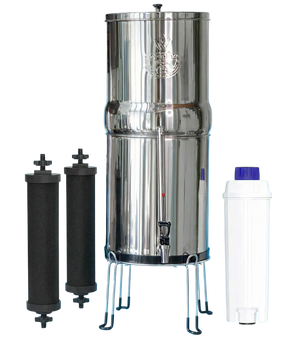
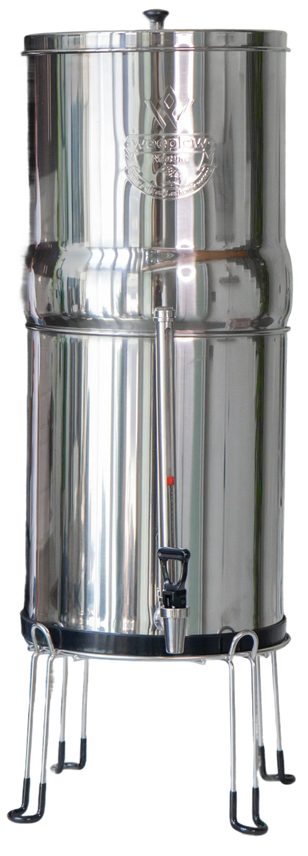
At Weeplow, our gravity-fed systems contain activated carbon, which adsorbs a wide range of contaminants including chlorine, heavy metals and PFAS.
Chlorine remains a practical and effective disinfectant that protects drinking water from harmful micro-organisms. However, it can also affect taste, smell and raise broader concerns.
While alternatives exist, they are often more expensive or harder to implement.
That is why reducing exposure through good daily habits and effective filtration is often the most practical solution. Browse our shop to find the gravity-fed water filtration system best suited to your needs.
Nitrat kommt natürlich in Böden, Pflanzen und Wasser vor. Erhöhte Konzentrationen können jedoch insbesondere im Grundwasser auftreten. Erfahren Sie, wie der Nitratgrenzwert in Deutschland geregelt ...
Nitrate can occur naturally in water, but higher concentrations can come from sources such as agriculture and wastewater. Learn how drinking-water limits work, where nitrate comes from, how to test...
Nitrates et méthémoglobinémie : quels risques pour l’eau du robinet ? Comprenez le lien entre ces deux éléments et ce que cela signifie pour votre eau au quotidien.
Researchers are increasingly studying the possible effects of chronic exposure to nitrates in drinking water. Here is what current research actually says about the potential risks associated with l...
Introduction Each year, a French household spends hundreds of euros on bottled water. It is carried home from the supermarket, stored in the kitchen, reassured by the image of mountains on ...